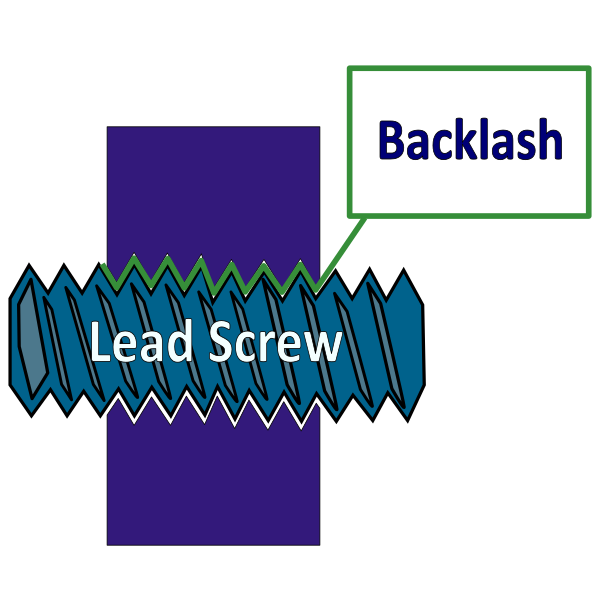
In mechanical engineering, backlash (also called lash, play, or slop) is the clearance or lost motion in a mechanism caused by gaps between mechanical components.
It can be defined as:
“The maximum distance or angle through which any part of a mechanical system may be moved in one direction without applying appreciable force or motion to the next part in the mechanical sequence.”
(Source: Wikipedia)
On a CNC milling machine, backlash appears when an axis changes direction.
For example:
The machine moves +20 mm on the X axis
Then it moves –20 mm on the X axis
If the X axis has backlash, the machine will not immediately start moving when the direction changes. There will be a small delay (lost motion) before the mechanical components re-engage.
As a result, the return movement will not be exactly 20 mm.
Backlash directly affects:
Dimensional accuracy
Circular interpolation precision
Surface finish
Repeatability
Software Backlash Compensation is a method used by the CNC controller to compensate for mechanical backlash.
When an axis changes direction:
The controller knows the configured backlash value
It adds a small corrective movement
This fills the mechanical “lost motion” before continuing normal travel
This improves positioning accuracy without modifying the machine mechanically.

All SourceRabbit Motion Controllers, when used together with Focus CNC, support Software Backlash Compensation.
This feature is available across the entire SourceRabbit motion control ecosystem.
To enable it:
Measure the backlash for each axis
Enter the backlash value (in millimeters or degrees) in the axis parameters inside Focus
The controller will automatically compensate backlash on every direction change
No additional hardware is required.
Software backlash compensation:
Improves positioning accuracy
Reduces dimensional error
Enhances repeatability
However, it does not replace proper mechanical design.
For production-level CNC systems, high-precision mechanical components remain the correct long-term solution.